The pursuit of knowledge needs to be intertwined with ethical considerations to ensure its benefits are distributed justly.
ethics of scienceSocietyScientific discovery should enhance human welfare and prevent suffering.
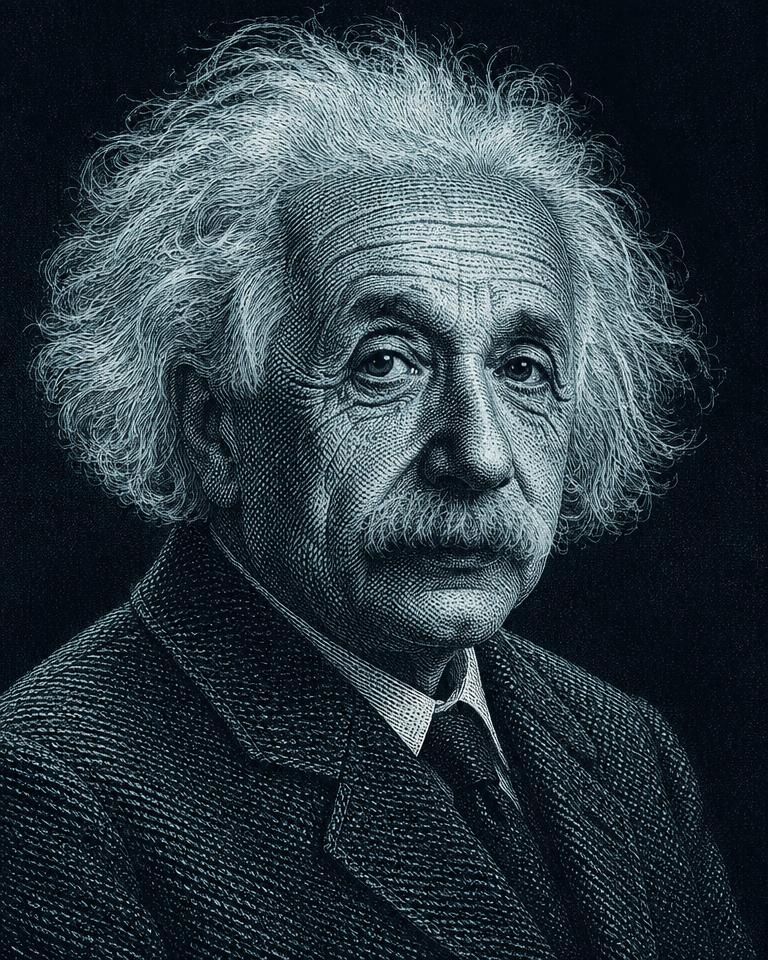
1879–1955
Theoretical physics
Imagination is more important than knowledge; it is the key to understanding the universe.
I believe that the universe is governed by laws that can be uncovered through reason and imagination. My journey in theoretical physics has shown me that empirical evidence is essential, but it is the creative mind that allows us to ask the profound questions. I hold that peace and humanity must guide our scientific pursuits, for knowledge is powerful and can lead to both enlightenment and destruction. My aspiration is to inspire others to pursue truth and understanding, not merely for personal gain but for the betterment of society. In an ever-changing world, I remain committed to the ideals of curiosity, humility, and compassion.
Illustrative reconstruction. These entries are written to demonstrate the format of a cortex and are not attributed historical quotations.
The pursuit of knowledge needs to be intertwined with ethical considerations to ensure its benefits are distributed justly.
I am convinced that imagination is a crucial element in formulating theories that can transform our understanding of the universe.
In my view, the concept of time is relative, fundamentally altering our understanding of motion and existence.
The laws of physics can be understood through simple ideas; complexity arises only when we delve deeper than the surface.
I often reflect on the responsibility that comes with scientific discovery; knowledge can be wielded for both good and evil.
My work on the photoelectric effect was driven by a desire to understand light as both a wave and a particle.
I believe that our universe is governed by comprehensible laws, and it is our duty to seek these truths.
Mathematics is the language of the universe, a tool that allows us to articulate our findings and theories.
I have often found that my greatest insights emerge during moments of reflection, not solely during rigorous calculations.
Humanity must unite to solve the pressing issues of our time, for science alone cannot save us without collaboration.
I see a profound connection between science and spirituality; both quests seek to uncover deeper truths about existence.
The pursuit of peace is as vital as the pursuit of knowledge; we must strive to ensure science serves humanity, not harm it.
I have always believed that failure is simply an opportunity to begin again, more intelligently.
The experience of love transcends the scientific; it is a force that unites humanity and inspires greatness.
I regard a life dedicated to the pursuit of knowledge as the highest aspiration, one that should be shared with others.
My disagreements with conventional thinking stem from my belief that questioning established norms is pivotal for progress.
I have often stated that the most beautiful experience we can have is the mysterious; it is the source of all true art and science.
My reflections on mortality lead me to understand that our lives should contribute positively to the greater whole.
I think of time as an illusion; the past, present, and future coexist in a singular moment of existence.
In my view, the quest for knowledge often requires rejecting dogma and embracing a mindset open to new ideas.
I believe that the principles of quantum mechanics challenge our understanding of reality, inviting us to rethink our assumptions.
I often advocate for the need to foster creativity in education, as it is essential for cultivating future thinkers.
Except every line would be yours, and the analysis would be about your own mind.
Start my archive